Oudry's Masterpiece: A Deeper Look at "A Hare and a Leg of Lamb"
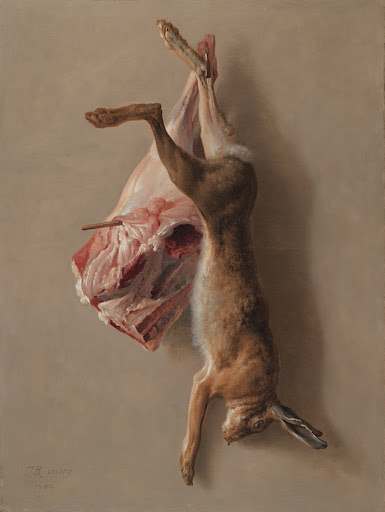
Jean-Baptiste Oudry's 1742 still-life painting, A Hare and a Leg of Lamb, is far more than a mere depiction of game. This oil on canvas masterpiece, measuring 98.2 x 73.5 cm unframed, invites viewers into a complex world where artistic prowess meets historical context. Signed "J.B. Oudry / 1742" on the lower left, the work is a prime example of French Rococo elegance interwoven with a striking naturalism, a hallmark of Oudry's celebrated career. At its heart, the painting showcases a meticulously rendered dead hare and a skinned leg of lamb, dramatically nailed to a stark wall. But beyond its stunning visual appeal, this artwork tells a compelling story of art, abundance, and the stark realities of 18th-century France, particularly in the shadow of widespread famine.
Oudry's Brushwork: A Feast for the Eyes and Mind
Jean-Baptiste Oudry (1686–1755) carved a niche for himself as a leading painter of animals and still-life compositions during the Enlightenment era. His unique ability to marry the decorative charm of Rococo with an almost scientific accuracy of observation set him apart. In A Hare and a Leg of Lamb, Oudry employs the sophisticated technique of trompe-l'œil, literally "deceive the eye," to create an illusion of three-dimensionality that is remarkably convincing. This mastery is immediately evident in the palpable textures he conjures: the soft, mottled fur of the hare contrasts sharply with the glistening, raw flesh of the leg of lamb.
The painting's deceptively simple composition, featuring a sterile background, serves to amplify Oudry's extraordinary skill in rendering these textures. Every strand of fur, every sinew and muscle fiber in the lamb's raw cut, is depicted with an almost photographic precision. This emphasis on scientific accuracy and detailed observation was highly valued during the Enlightenment, a period that championed reason and empirical knowledge. Oudry’s work, therefore, wasn't just decorative; it was a testament to the era’s intellectual currents, transforming a still-life into a study of nature's intricacies. For a closer look at this particular artistic technique, explore The Trompe-l'œil Mastery of Oudry's Leg of Lamb Painting.
The careful rendering of the skinned leg of lamb is particularly significant. It's not just a generic piece of meat; it's a specific, recognizable cut, revealing the artist's keen eye for detail and perhaps a direct engagement with the realities of the butcher's block. This level of realism would have been immediately appreciated by contemporary viewers, especially those familiar with hunting and culinary practices.
The Paradox of Abundance: A Leg of Lamb in Times of Scarcity
One of the most profound aspects of Oudry's A Hare and a Leg of Lamb lies in its historical context. This lavish celebration of game and abundance was created in 1742, a mere year after France had been ravaged by a severe famine. The period leading up to 1741 saw crop failures, harsh winters, and widespread food shortages, leading to immense suffering and death across the country. Against this backdrop of national hardship, Oudry’s painting presents a stark contrast: a visual feast of prime game and a substantial leg of lamb.
This juxtaposition highlights a critical social and economic divide. While much of France endured hunger, the wealthy aristocracy and burgeoning bourgeoisie, for whom such paintings were commissioned, lived in a world of relative plenty. The artwork was typically intended for display in grand hunting lodges or opulent dining rooms, spaces where the bounty of the hunt and the rewards of prosperity were proudly showcased. The presence of a prominent leg of lamb, a cut historically associated with celebration and nourishment, would have served as a powerful symbol of status and good fortune to these elite patrons.
The painting, therefore, can be interpreted in several ways: as a defiant assertion of wealth and privilege amidst national scarcity, a psychological escape into a world of endless bounty, or perhaps even a form of aspirational art, projecting a desired future of plenty. It reflects not just an artistic style, but the very fabric of 18th-century society, where art often served to reinforce social hierarchies and offer a curated vision of the world for those who could afford it.
Beyond the Canvas: The Enduring Symbolism of the Leg of Lamb
While Oudry's painting captures a raw leg of lamb, its inclusion speaks volumes about the cut's timeless significance. Historically, lamb, and particularly the leg, has been a prized food item across numerous cultures, symbolizing sustenance, celebration, and culinary richness. In Oudry's era, it represented a valuable source of protein and a marker of a well-stocked larder, a luxury not afforded to all. The careful depiction underscores not just its artistic value but also its inherent worth as food.
Even today, the leg of lamb holds a special place in global cuisine. It's a centerpiece for festive occasions, from Easter dinners to holiday feasts, celebrated for its robust flavor and versatility. Modern culinary practices continue to honor this cut, whether slow-roasted with herbs, braised until tender, or butterflied and grilled. Its rich texture and distinct taste make it a perennial favorite for those seeking to create memorable dining experiences. For instance, pairing a succulent roasted leg of lamb with rosemary and garlic is a timeless classic, offering a comforting and flavorful meal that transcends centuries. Choosing a bone-in leg can impart even more flavor during cooking, a fact that perhaps Oudry, ever the naturalist, implicitly understood.
The visual presence of the leg of lamb in Oudry’s painting transcends its raw state; it taps into a collective understanding of food as both necessity and luxury, a theme that resonates even with contemporary audiences who might appreciate its culinary appeal while reflecting on its historical context.
A Masterpiece's Journey: From Rococo France to the Cleveland Museum
Oudry's A Hare and a Leg of Lamb has a rich provenance, tracing its journey through various distinguished French private collections. Sales at prestigious venues like Galerie Charpentier in 1958 and Palais Galliera in 1963 marked its passage through significant art markets. Eventually, the painting found its way to American ownership before making its permanent home at the Cleveland Museum of Art in 1969, acquired through the generous John L. Severance Fund. Today, this captivating artwork can be admired by the public in Gallery 216B, dedicated to French and German art, offering a window into 18th-century artistic and societal values.
The Cleveland Museum of Art's commitment to accessibility is further highlighted by its Open Access policy, which ensures that the image of A Hare and a Leg of Lamb, along with many other treasures, is freely available for copying, modification, and distribution. This modern approach to art dissemination allows the painting's powerful message and Oudry's exceptional skill to reach an even wider global audience, fostering education and appreciation. To delve deeper into the museum's collection and the specific placement of this extraordinary piece, check out Discovering Oudry's 18th-Century Still Life at Cleveland Museum.
Conclusion
Jean-Baptiste Oudry's A Hare and a Leg of Lamb stands as a monumental achievement in 18th-century still-life painting. It is a testament to Oudry's unparalleled ability to combine Rococo elegance with scientific naturalism, making every texture, from the hare's fur to the raw leg of lamb, come alive. Beyond its aesthetic brilliance, the painting serves as a potent historical document, reflecting the stark contrast between abundance and famine in 1740s France. It reminds us that art often mirrors society, revealing not only beauty but also underlying truths about privilege, survival, and the enduring human relationship with food. This magnificent work continues to captivate and provoke thought, ensuring Oudry's legacy as a master whose brush captured both the tangible and the symbolic.
